

Everyone Looks Qualified. How Can You Tell Who Can Actually Do the Job?
A strong job posting can bring in hundreds of applicants. A successful career fair can put recruiters in front of dozens of promising candidates in a few hours.
Then comes a harder question: what happens when a lot of them look qualified?
The resumes are polished. The right skills are listed. Candidates have prepared stories about teamwork, leadership, problem-solving, and conflict. After a while, everyone can start to sound good.
This is where screening needs to do more than confirm experience. Recruiters need questions that show how someone actually thinks, makes decisions, handles tradeoffs, and gets results.
Here are practical ways to get there.
Start With the Hard Parts of the Job
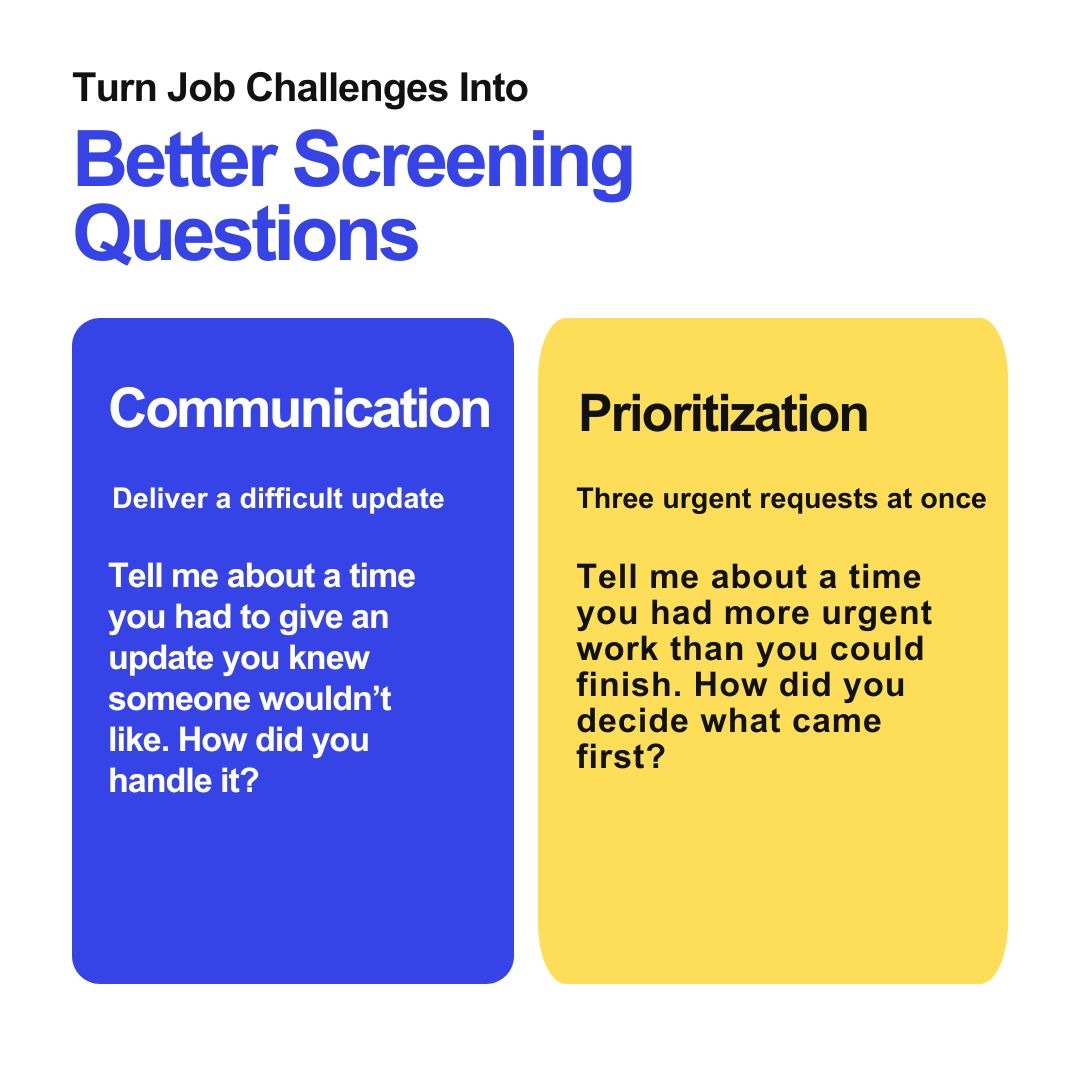
Before writing screening questions, ask the hiring manager:
“What situations make this job difficult?”
That question usually gives you more to work with than a list of soft skills.
Instead of:
We need someone with strong communication skills.
You might learn:
This person often has to explain delays to frustrated clients.
Instead of:
We need someone who can prioritize.
The real challenge might be:
Three departments may ask for urgent work at the same time, and this person has to decide what moves first.
Now you have something you can screen for.
For the first example, ask:
“Tell me about a time you had to give a client or stakeholder an update you knew they would not like. How did you handle it?”
For the second:
“Tell me about a time you had more urgent work than you could realistically finish. How did you decide what came first?”
This follows the same basic idea behind structured interviewing: questions should connect directly to the work candidates will actually be expected to do. Our guide to behavioral interviews also explains how real past experiences can help employers assess skills such as judgment, communication, and adaptability.
Ask About a Decision, Not Just a Challenge
A question like “Tell me about a challenge you faced” leaves plenty of room for a rehearsed story.
Make the candidate explain a decision.
Try:
“Tell me about a project where you had two reasonable options and had to choose one. What did you choose?”
Then ask:
“Why?”
That one-word follow-up can tell you a lot.
Keep going if needed:
“What made the other option less attractive?”
“What information did you have at the time?”
“Who disagreed with your decision?”
“What would have changed your mind?”
“Would you make the same choice today?”
Recent guidance from Metaview includes questions built around decisions, disagreements, leadership choices, and changing course after reflection. The value comes from getting beyond what happened and into how the candidate reached the decision.
A candidate who says, “I picked the highest-priority project,” has not given you much yet.
A candidate who explains that one project affected a client renewal, another deadline had flexibility, and a third task could be reassigned has given you real information about their judgment.
Move the Answer From “We” to “I”
Team accomplishments can make everyone sound impressive.
A candidate says:
“We changed our onboarding process and improved retention.”
Follow with:
“What part did you own?”
Then:
“What did you personally change?”
“Which decision was yours?”
“Who else contributed?”
“Where did the team disagree?”
The goal is not to make candidates claim all the credit. In fact, a strong answer often gives clear credit to other people.
What you want to understand is where the candidate’s contribution starts and ends.
The same approach works with resume statements like:
- “Increased sales by 20%”
- “Reduced processing time”
- “Led a product launch”
- “Improved customer satisfaction”
Do not stop at the result. Ask how they got there.
Make Them Explain the Result
Suppose a candidate says:
“I improved our reporting process.”
Ask:
“What was wrong with the old process?”
“What was the first thing you changed?”
“How did you know the new process was better?”
“Who actually used it?”
“What happened after the change?”
The candidate does not need perfect memory or an exact metric for every project.
You are looking for a clear connection between the problem, their action, and the outcome.
This also gives recruiters better notes. “Strong communicator” tells the next interviewer almost nothing. “Identified a reporting delay, changed the handoff process, and cut two approval steps” gives them something they can actually use.
TalentAlly has covered the same issue from the measurement side in its guide to using interview data: useful hiring data comes from capturing consistent evidence rather than relying on vague impressions.
Change One Detail in the Scenario
Past examples tell you what a candidate has already done. A short work scenario can show how they react to a new problem.
For example:
“A client asks for a major change the day before a deadline. Your team cannot complete everything they requested. What do you do?”
Let the candidate answer.
Then add:
“Now the client says the change is required for launch.”
See what changes.
Or add:
“Your manager is unavailable for the rest of the day.”
A useful answer may include questions before action:
- What part of the request is actually required?
- What happens if the deadline moves?
- Who else needs to know?
- Can the work be split into phases?
- Which decision can I make myself?
That can be more revealing than a candidate immediately producing a confident answer.
Real jobs contain missing information. Candidates who know how to identify what they need before making a decision are showing you part of how they work.
Give Them a Small Piece of the Job
Sometimes the simplest way to check a skill is to see the candidate use it.
For a marketing role:
“Here is a short campaign brief. What would you change first?”
For sales:
“Here are five leads. Which three would you contact first?”
For operations:
“Five issues came in this morning. Put them in the order you would handle them and talk me through your reasoning.”
For a manager:
“A high performer has missed two deadlines and another team has complained about working with them. How would you prepare for that conversation?”
Keep the task small. A screening exercise does not need to turn into a large unpaid assignment.
The point is to create a small moment where candidates have to demonstrate the skill instead of describing it.
This is becoming especially relevant in skills-first recruiting. Metaview identifies structured work samples, portfolio review, and competency-based interviews as important screening approaches in 2026.
Know What You Are Listening For
 Even a great question can become useless if interviewers have no shared idea of what makes an answer strong.
Take this question:
“Tell me about a time you had too many priorities.”
Before the interview, decide what evidence matters.
A strong answer might show that the candidate:
- looked at urgency and business impact
- identified dependencies
- made a clear tradeoff
- communicated with affected people
- adjusted when circumstances changed
- understood the result afterward
A weak answer might stay vague:
“I just organized everything and got it done.”
The answer sounds positive. It gives you almost no evidence.
This is where a simple scorecard becomes useful. Recruiters can define the signals they want before meeting candidates, then evaluate each person against the same criteria instead of deciding afterward who “felt strongest.”
Build a Small Follow-Up Bank
High-volume hiring usually means recruiters cannot spend ten minutes digging into every answer.
They do not need to.
Give interviewers six follow-ups they can use whenever an answer feels incomplete:
Ownership
“What did you personally own?”
Reasoning
“Why did you choose that?”
Tradeoff
“What did you have to give up or delay?”
Evidence
“How did you know it worked?”
Alternative
“What else did you consider?”
Reflection
“What would you do differently now?”
The recruiter chooses the follow-up that matches the missing information.
Hiring managers can use the same approach. Our guide to interviewer training recommends giving interviewers structured questions, clear job-related criteria, and practice before they evaluate candidates.
When every candidate looks qualified, the answer is rarely adding another generic interview question.
Go deeper on fewer questions.
Ask about a real decision. Find out what the candidate personally owned. Dig into the result. Change one part of the scenario. Give them a small piece of the work when the skill is important enough to test directly.
A polished answer can tell you that someone prepared for the interview. The details tell you how they actually work.
