
Hiring in Different Cities? Your Recruiting Strategy Should Change Too
Hiring the same role in several cities often starts with one requisition, one job ad, and one sourcing plan. Results can still vary sharply because local talent supply, pay, commuting patterns, employer competition, and candidate expectations differ.
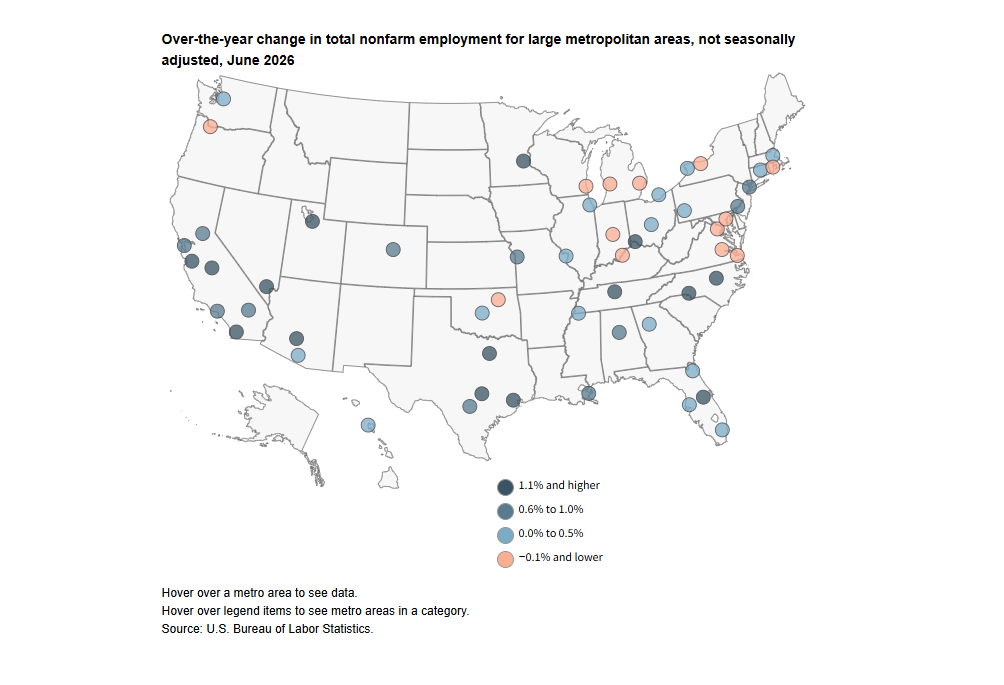
In June 2026, 15 of 387 metropolitan areas had unemployment rates below 3.0%, while seven had rates of at least 8.0%. Among 56 large metro areas, payroll employment grew over the year in 10, declined in two, and was essentially unchanged in 44. The figures are not seasonally adjusted, and unemployment alone cannot measure the supply of qualified people for a specific job. The variation still shows why a national average cannot guide every local campaign.
Local differences should shape your regional hiring strategy, including how the role is advertised, where candidates are sourced, and what recruiters discuss with them.
Build a Role-Specific City Brief
A metro area with higher unemployment can still have a shortage of nurses, technicians, engineers, or other specialized workers. Review each market at the occupation level before deciding how difficult a role will be to fill.
Create a one-page brief for each role and city. Include:
- Local employment and typical pay for the occupation
- Employers competing for similar skills
- Where workers live and how far they commute
- Shift, transportation, or on-site requirements
- Nearby training programs and sources of adjacent skills
- Local rules affecting job postings or compensation
BLS OEWS data provides metro-level employment and wage estimates. Census OnTheMap shows where people work and live. Add your ATS results, offer declines, recruiter notes, and candidate questions. Use the brief to set pay, ad radius, messaging, and channels.
Rewrite More Than the Location Line
Changing the city name at the top of a job description is rarely enough. Each local version should state the worksite or service area, on-site expectations, shift, travel, salary range, required credentials, and hiring timeline.
The emphasis can change with the market. Transit access may matter for a downtown location. An exact schedule and parking information may matter more for a suburban evening shift. Keep the role’s duties and selection standards consistent while making the practical details local.
Compliance also varies. New York City requires a good-faith pay range in job advertisements, while Illinois requires pay scale and benefit information in covered postings. Have your legal or compliance team confirm the rules for every market, including remote roles tied to a location.
Set the Sourcing Mix by City
Using the same channels and budget everywhere can waste time. A tight or specialized market may need focused outreach, referrals, local associations, and faster recruiter response. A market producing high application volume may need clearer qualifications and a stronger screening process.
Local workforce centers, colleges, alumni groups, trade organizations, and community partners can reach people outside the usual national job boards. Judge each source by qualified candidates, interviews, and hires.
When a city needs wider reach, TalentAlly job postings can extend an opening through a broad partner network. Pair that distribution with local outreach so each channel has a clear job to do.
Match the Event Format to the Hiring Geography
An in-person event can work well for roles tied to one facility and a realistic commute. A market-specific virtual event gives local candidates recruiter access without requiring travel. A nationwide virtual event can support remote roles or the same job family across several cities, as long as candidates can quickly identify the openings that match their location.
TalentAlly career fairs include nationwide and market-specific virtual, in-person, and hybrid options. Choose the format that matches the roles.
For each city, recruiters should have the exact openings, locations, qualifications, work arrangements, and next steps. Carry those details into event follow-up so candidates receive information for the right market.
Give Recruiters a Local Talk Track
Prepare recruiters to answer the questions they hear most in each city. These may cover commute, schedule, pay, hybrid expectations, relocation, or the local hiring timeline.
Record repeated questions and objections. A transportation concern raised again and again should reach the hiring manager. If compensation ends several promising conversations, review the offer before spending more on sourcing. Candidate feedback can improve a campaign while the role is still open.
Compare City Funnels With the Same Measures
Localization works best when every city uses the same scorecard. Track:
- Completed application rate
- Qualified applicant rate
- Screen-to-interview rate
- Offer acceptance
- Time to fill
- Hires by source
- Early retention, when available
Use the same definitions and reporting period in every market. Many views with few applications may point to pay, schedule, location, or application friction. High application volume with a low qualified rate may signal weak targeting. Strong interviews followed by rejected offers may call for a review of compensation, speed, or candidate communication.
Application totals alone cannot tell you whether a city is difficult. The goal is one shared standard for hiring quality and measurement, with local decisions about messages, channels, events, and recruiter preparation.
Start with one repeated role in two or three cities. Build the briefs, run the campaigns for a set period, compare the funnels, and adjust. This gives recruiters a practical way to use local information while keeping the broader hiring strategy consistent.
